Laura's Selection
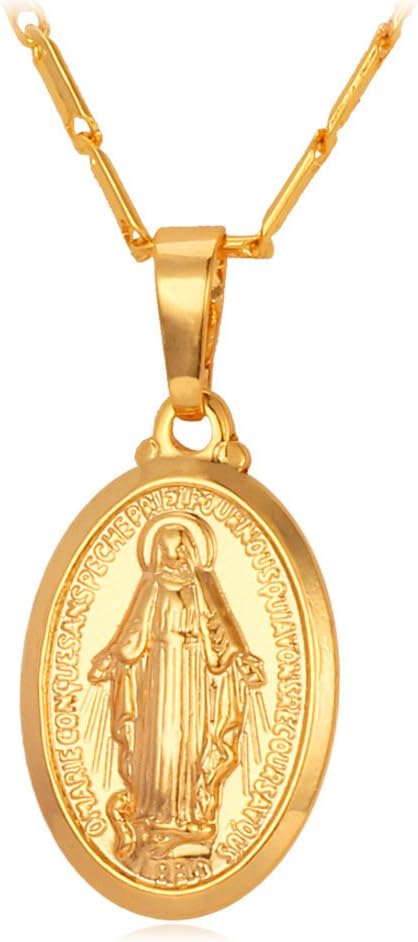
U7 Virgin Mary Necklace for Women,18K Gold Plated/Sterling Silver
18K Gold Plated / Baño de Oro 18K con acabado de orfebrería fina.
Prime Delivery Guaranteed
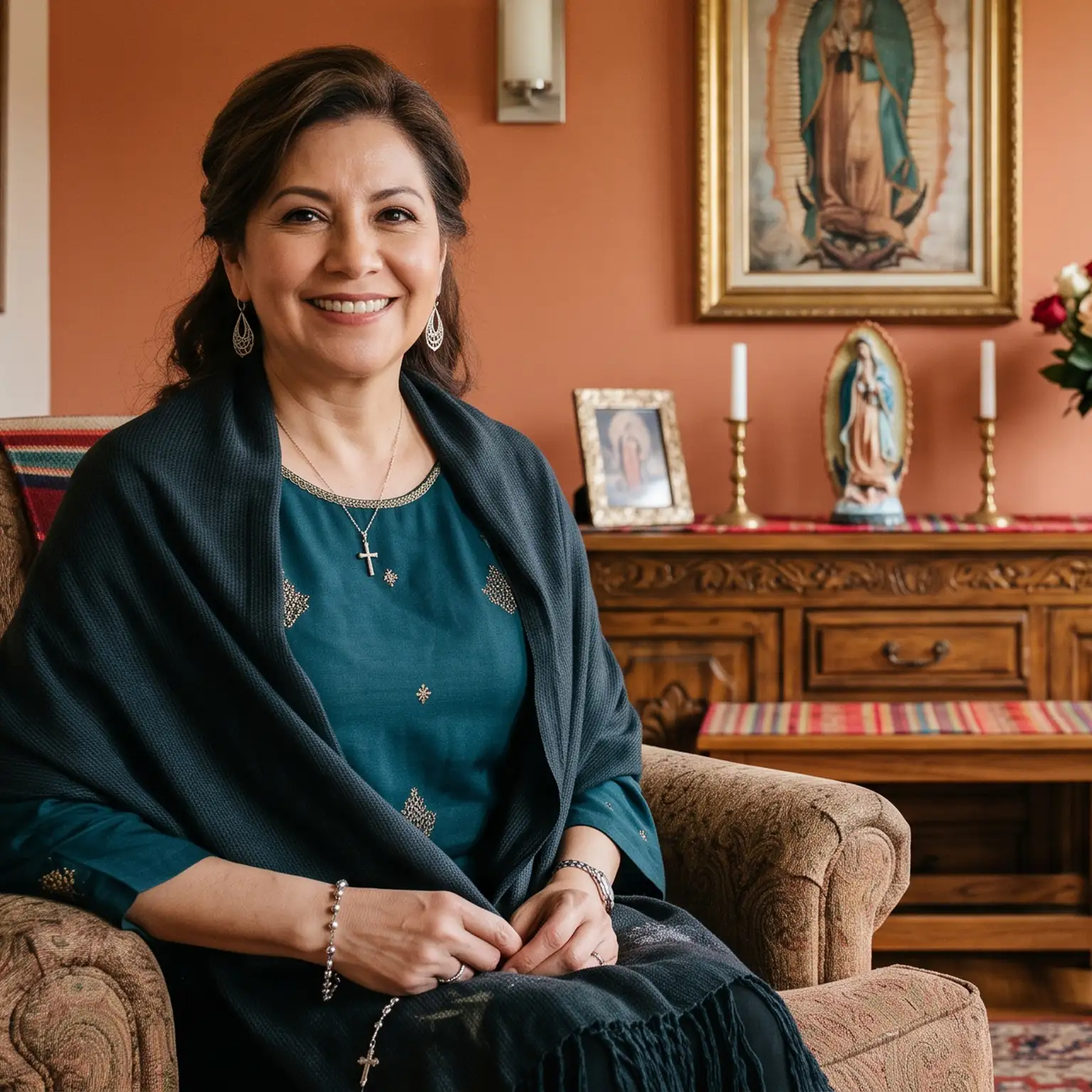
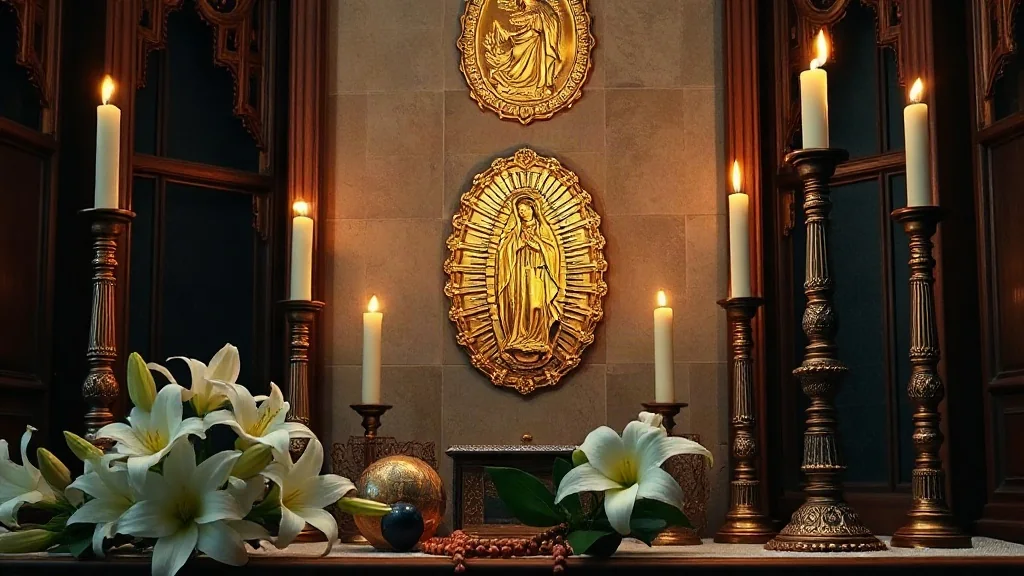
The image of Our Lady of Guadalupe is not merely a devotional painting but a sophisticated theological treatise written in the visual language of the sixteenth century. For the trained eye of a researcher and curator of sacred arts, every line, color, and ornament on the tilma of Juan Diego serves as a precise semiotic marker designed to bridge two worlds: the ancient Mesoamerican cosmos and the revealed Truth of the Christian faith. Among these elements, the *cozcatl*—the necklace or neck ornament—and the *pepeyoctli*—the brooch or pendant—stand as some of the most profound markers of identity and mission. Far from being simple decorative additions, these ornaments function as a visual proclamation of the Incarnation, signaling to the indigenous observer that the woman depicted is not a distant deity, but a mother carrying within her the Source of Life. From a spiritual perspective, the *cozcatl* represents the intersection of human dignity and divine election. In the Nahua tradition, jewelry was never merely ornamental; it was a manifestation of status, a sign of ritual consecration, and a poetic metaphor for the preciousness of existence. When this indigenous concept is integrated into the Marian image, it undergoes a process of spiritual transfiguration. The ornament no longer points toward earthly nobility or local deities, but toward the Christocentric reality of the Virgin Birth. The *cozcatl* thus becomes a celestial seal, announcing that Mary is the Tabernacle of the Most High, and that the "precious gift" she carries is the Savior of mankind. This synthesis of culture and faith allows the image to speak a universal language of love and redemption, rooted in the specific soil of the Tepeyac.
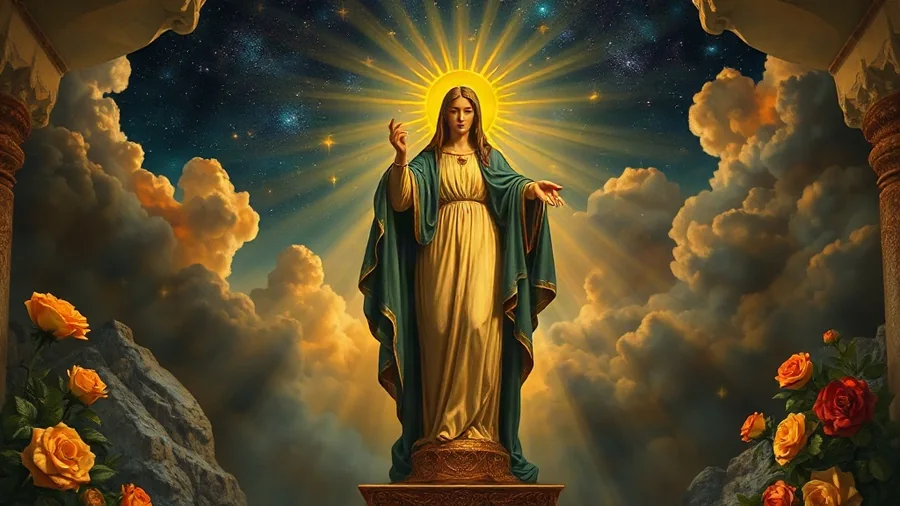
To comprehend the significance of the *cozcatl*, one must first analyze the sacred geography of the Tepeyac hill. Long before the events of 1531, this site was a locus of profound spiritual activity for the indigenous peoples of the Valley of Mexico. It was associated with female deities linked to fertility, the earth, and the cycles of life, most notably Tonantzin, whose name translates to "Our Venerated Mother." The pre-Hispanic world viewed the female principle as the conduit for life and sustenance, and the symbols of maternity and fecundity were deeply embedded in the ritual life of the region. Consequently, when the image of the Virgin appeared, it did not emerge in a vacuum but in a space already sensitized to the concept of a divine feminine presence associated with the nurturing of life.
The pivotal moment occurs in December 1531, when the miraculous impression of the image appeared on the ayate of Juan Diego. In this divine "writing," the *cozcatl* and *pepeyoctli* were meticulously placed. For the early sixteenth-century Nahua observer, the sight of a woman wearing a collar and a brooch was a clear poetic signal. In the sophisticated floral and metaphorical language of the Aztecs, the arrival of a newborn child was often described in poetry as the arrival of a "necklace and a brooch." By incorporating these specific elements, the image utilized a known cultural idiom to announce a biological and spiritual reality: the pregnancy of the Virgin. This was a masterstroke of divine inculturation, translating the mystery of the Incarnation into a visual dialect that the indigenous population could intuitively grasp.
As the seventeenth and eighteenth centuries progressed, the interpretation of these ornaments evolved through the writings of chroniclers and theologians. The initial indigenous reading of "new life" was formally integrated into Catholic dogma. Scholars began to emphasize that the brooch—the *pepeyoctli*—was not a generic ornament but was signated with the cross of Christ. This transition is crucial; it marks the point where the indigenous symbol of fertility is "baptized" and reoriented. The focus shifted from a general celebration of life to the specific celebration of the Life-Giving Word made flesh. The *cozcatl* thus became a marker of the *Theotokos* (God-bearer), confirming that the child in her womb was the crucified and risen Lord.
In the modern era, the study of the *cozcatl* has moved into the realm of rigorous iconographic and historical analysis. We now recognize that the image does not seek to replace the indigenous identity but to fulfill it. The continuity between the ancient veneration of the "Mother" at Tepeyac and the devotion to the Virgin of Guadalupe is mediated through these symbols. The *cozcatl* serves as a historical bridge, proving that the Gospel does not destroy the beauty of the culture it enters but elevates it. The chronology of the symbol moves from a prehistoric sign of fertility, to a sixteenth-century announcement of birth, and finally to a perennial symbol of the Christocentric nature of Marian devotion.
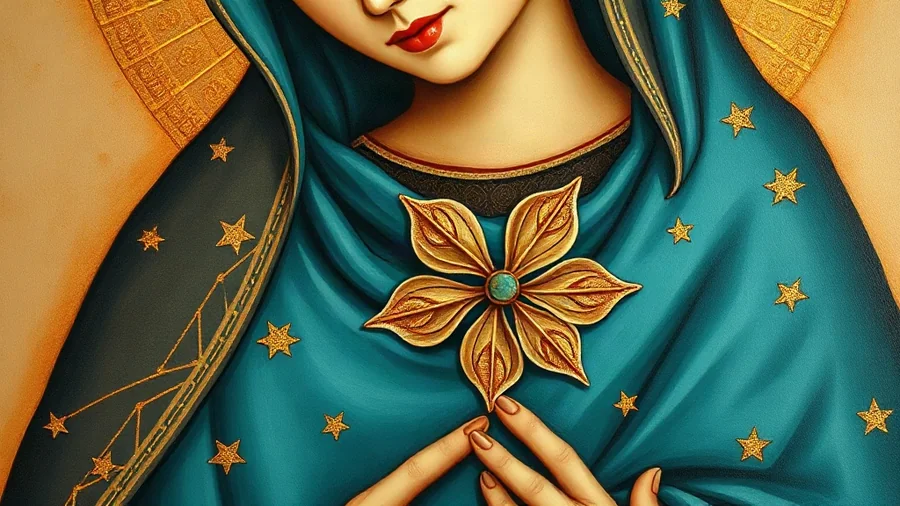
The theological weight of the *cozcatl* is centered on the doctrine of the Incarnation. In Catholic theology, Mary is the *Porta Coeli* (Gate of Heaven), the point through which the Divine entered the temporal world. The presence of the necklace and brooch serves as a visual confirmation of her pregnancy. While the overall posture of the Virgin—with her hands joined in prayer and her slight lean—suggests a state of expectancy, the *cozcatl* acts as the definitive seal. It transforms the image from a portrait of a saint into a portrait of a Mother. The theological message is clear: the dignity of the woman is derived from the dignity of the Child she carries.
Furthermore, the *cozcatl* emphasizes the concept of Christocentrism. A common misconception in popular piety is to view the Virgin as an independent source of power; however, the sacred jewelry of the Guadalupe image corrects this error. Because the brooch is marked with the cross, the ornament directs the viewer's gaze away from Mary and toward Christ. The jewelry does not belong to Mary as a personal possession, but as a sign of her office as the Handmaid of the Lord. The cross at the center of the *pepeyoctli* signifies that the purpose of the Incarnation is the Redemption. The "precious gift" mentioned in Nahua poetry is revealed to be the Lamb of God, who comes to offer His life for the salvation of the world.
The concept of inculturation is also profoundly present in this ornament. Inculturation is the process by which the Gospel takes root in a specific culture, adopting its forms to express a universal truth. By using the *cozcatl*, the Divine Message acknowledges the validity of the Nahua experience. It suggests that the longing for a "Mother" and the celebration of "new life" present in the pre-Hispanic world were precursors to the full revelation of Christ. The symbol is not erased; it is redeemed. This teaches the faithful that their own cultural identities are not obstacles to faith but are, in fact, the very vessels through which God chooses to reveal Himself.
Finally, the *cozcatl* represents the "consecration" of the human person. In the ancient world, a collar of precious stones or gold was a sign that the wearer was set apart for a sacred purpose. Mary, wearing the *cozcatl*, is presented as the most consecrated of all creatures. She is the *Immaculata*, the one preserved from all stain, and her "jewelry" is a reflection of the grace that adorns her soul. For the devotee, contemplating the *cozcatl* is an invitation to consider their own consecration to God. Just as the Virgin is adorned by the grace of her divine motherhood, the Christian is called to be adorned by the virtues of faith, hope, and charity, becoming a living reflection of the divine light.
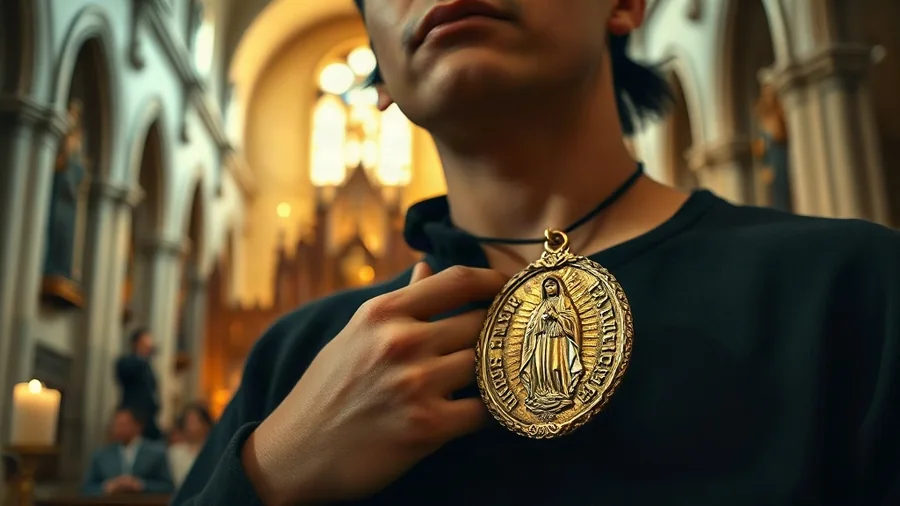
As a curator of sacred jewelry, I view the *cozcatl* not only as a symbol but as a prototype for the creation of devotional art. When translating these celestial symbols into physical objects—such as medals, necklaces, and pectorals—the choice of material is paramount. In the realm of high sacred jewelry, 14K gold and 925 sterling silver are the standards of excellence. Gold, with its incorruptibility and solar radiance, has historically symbolized the Divine, the Eternal, and the Kingship of Christ. A medal of Our Lady of Guadalupe cast in 14K gold is not an exercise in luxury, but a theological statement: the purity of the metal reflects the purity of the Virgin and the royalty of the Messiah she carries.
The use of 925 sterling silver provides a complementary symbolic dimension. Silver, associated with the lunar and the reflective, represents the Virgin Mary, who does not possess light of her own but reflects the light of her Son. When a devotional piece combines both gold and silver, it creates a visual dialogue between the Divine (Gold) and the Human-Reflective (Silver), mirroring the dual nature of Christ. From a technical standpoint, the 925 hallmark ensures a high purity of silver, providing the necessary durability for pieces intended to become family heirlooms. The craftsmanship involved in these pieces—whether through lost-wax casting or meticulous hand-engraving—must mirror the precision found in the original image of the Tepeyac.
The care and maintenance of such sacred objects are essential to preserving their spiritual and material value. Gold and silver, while noble, require specific stewardship. I always advise collectors and the faithful to avoid harsh chemicals and to use only soft, lint-free cloths for polishing. The patina that develops on sterling silver over decades is often seen by curators as a "veil of time," a testament to the generations of prayers offered while wearing the piece. However, for those who prefer the original brilliance, a gentle cleaning restores the light, symbolizing the perpetual renewal of the soul through the sacraments.
Ultimately, the creation of a *cozcatl*-inspired piece of jewelry is an act of prayer. When a goldsmith meticulously carves the cross into the central brooch of a Guadalupe medal, they are participating in the same tradition of inculturation that defined the original image. These objects become "sacramentals"—tangible reminders of invisible graces. A high-quality piece of sacred jewelry, crafted with integrity and noble metals, serves as a bridge between the mundane and the divine, allowing the wearer to carry a piece of the Tepeyac's mystery close to their heart, ensuring that the legacy of the *cozcatl*—the announcement of new life—continues to resonate in the modern world.
18K Gold Plated / Baño de Oro 18K con acabado de orfebrería fina.
Prime Delivery Guaranteed
Stainless Steel / Acero Inoxidable con acabado de orfebrería fina.
Prime Delivery Guaranteed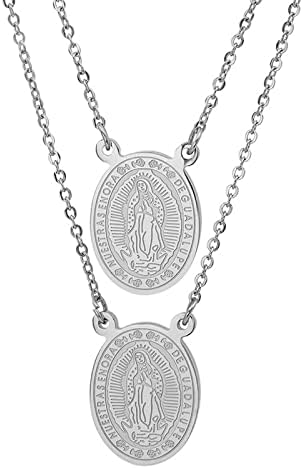
18K Gold Plated / Baño de Oro 18K con acabado de orfebrería fina.
Prime Delivery GuaranteedWhen selecting a Guadalupana piece, always prioritize certified precious metals (solid nickel-free 14K gold or Italian 925 sterling silver). Upon receiving it, take it to your parish priest for a traditional Catholic blessing to consecrate it as an enduring sacramental of protection.

18K Gold Plated / Baño de Oro 18K con acabado de orfebrería fina.
Prime Delivery Guaranteed
Gold Plated / Chapa de Oro con acabado de orfebrería fina.
Prime Delivery Guaranteed
925 Sterling Silver / Plata de Ley 925 con acabado de orfebrería fina.
Prime Delivery GuaranteedThe *cozcatl* (necklace) and *pepeyoctli* (brooch) are visual markers that communicate the pregnancy of the Virgin Mary using the cultural codes of the Nahua people. In the poetic language of the sixteenth-century Aztecs, these ornaments were metaphors for "newborn life" or a "precious gift." By wearing these items, the image of Our Lady of Guadalupe signaled to the indigenous population that she was carrying a child, effectively announcing the Incarnation of Christ in a way that was immediately understandable to them. Theologically, this meaning is deepened by the presence of the cross on the brooch. This detail transforms the indigenous symbol of fertility into a Christian symbol of redemption. It indicates that the child Mary carries is not merely any child, but the Savior of the world. Therefore, the *cozcatl* is a sign of divine motherhood, a marker of the Virgin's dignity as the *Theotokos*, and a visual bridge that integrates Mesoamerican culture into the universal mystery of the Gospel.
Yes, it is highly recommended that devotional jewelry be blessed by a priest. While the object itself is not a sacrament, a blessing transforms the piece into a "sacramental," which is a sacred sign designed to dispose the faithful to receive grace and to protect them from evil. The blessing consecrates the object for a holy purpose, reminding the wearer that the jewelry is not a mere fashion accessory but a tool for spiritual warfare and a reminder of their commitment to Christ and Mary. Regarding authenticity, one should always look for the "hallmark" or "stamp" on the metal. For gold, look for markings such as "14K" or "585." For silver, the standard mark is "925," indicating that the piece is 92.5% pure silver. I recommend purchasing from reputable jewelers who provide a certificate of authenticity. In the world of sacred art, the integrity of the material reflects the integrity of the devotion; using noble metals ensures that the object will endure for generations as a spiritual legacy.
Selecting devotional jewelry should be an act of discernment rather than a trend-driven purchase. One should choose a piece that resonates with their personal spiritual journey—for instance, a *cozcatl*-inspired piece if they feel a deep connection to the Incarnation or the protection of the Virgin of Guadalupe. The design should be elegant and timeless, avoiding excessive ostentation that might distract from the sacred nature of the image. The goal is for the jewelry to be a "silent prayer" that prompts the wearer and others to reflect on the divine. When wearing these pieces, it is important to maintain a spirit of reverence. Devotional jewelry should be worn with the intention of inviting God's presence into the day. It is a practice of "wearing one's faith," which can serve as a conversation starter about the Gospel or as a private anchor during moments of stress. I suggest wearing such pieces close to the heart, as a physical reminder that the heart is the true temple where the Divine wishes to dwell, mirroring the way Mary carried Christ in her womb.
Sacred jewelry serves as a powerful "intergenerational anchor." When a piece of high-quality gold or silver jewelry, such as a medal of Our Lady of Guadalupe, is passed from a grandmother to a granddaughter, it carries with it more than just material value; it carries the spiritual history of the family. The object becomes a physical manifestation of the prayers, sacrifices, and faith of the ancestors. This creates a tangible link between generations, reminding the youth that they are part of a larger, sacred story of faith. To foster family prayer, these objects can be integrated into domestic rituals. For example, a family might gather to pray the Rosary while wearing their heirloom medals, or a parent might give a *cozcatl*-inspired pendant to a child during their First Communion or Confirmation. By associating these noble objects with pivotal spiritual milestones, the family transforms the jewelry into a "sacred archive." The *cozcatl*, which originally announced the arrival of new life in the Tepeyac, continues to announce the presence of Christ in the home, ensuring that the flame of devotion is kept alive for future generations.
Affiliate Disclosure: As an Amazon Associate, this devotional portal earns from qualifying purchases at zero additional cost to you.
Find the perfect sacred piece in 3 simple steps
Handpicked based on your preferences and occasion