Laura's Selection
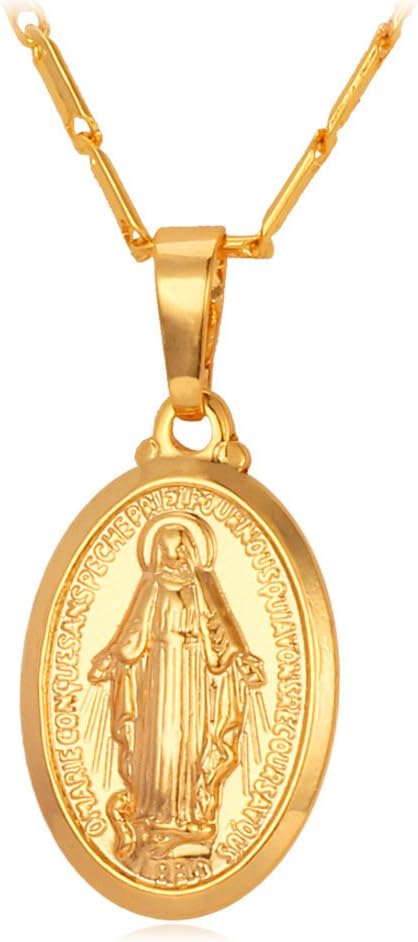
U7 Virgin Mary Necklace for Women,18K Gold Plated/Sterling Silver
18K Gold Plated / Baño de Oro 18K con acabado de orfebrería fina.
Prime Delivery Guaranteed

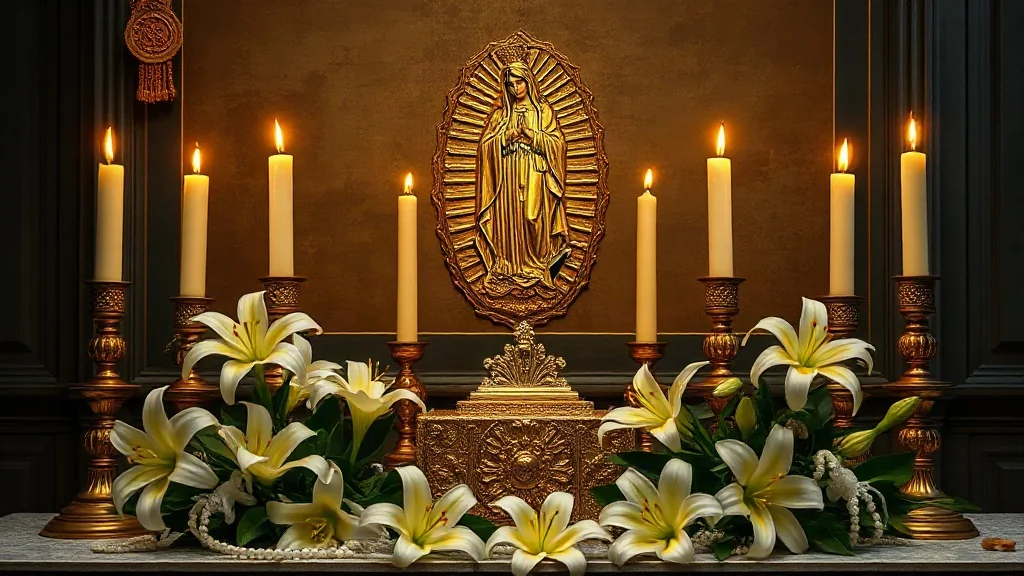
The image of Our Lady of Guadalupe is not merely a religious icon of profound devotion, but a complex semiotic tapestry where faith, history, and cosmology intertwine. For centuries, the gaze of the faithful has been drawn to the deep blue-green mantle that envelops the Virgin, a garment adorned with stars that seem to pulse with a celestial light. This "starry mantle" has become the center of a fascinating interdisciplinary debate, oscillating between the realm of divine revelation and the rigor of astronomical science. To contemplate these stars is to enter a dialogue between the earthly and the eternal, where the physical layout of the heavens is believed by many to be mirrored upon the humble agave fiber of Juan Diego’s tilma, suggesting that the apparition was not only a spiritual event but a cosmic one, synchronized with the very movements of the universe. From a spiritual perspective, the presence of these stars transcends simple ornamentation. In the Catholic tradition, the stars on the mantle signify the Virgin Mary as the "Star of the Sea" (Stella Maris), the guiding light that leads the soul toward Christ, the True Sun. The hypothesis that these stars represent the exact configuration of the sky over the Valley of Mexico on December 12, 1531, adds a layer of providential meaning: it suggests that the Mother of God brought with her a celestial map, a signature of the heavens to validate her presence to both the indigenous populations—who were master astronomers—and to future generations of believers. This intersection of astronomy and theology transforms the tilma into a "codex of the sky," where the divine architecture of the cosmos is woven into the maternal embrace of the Virgin.
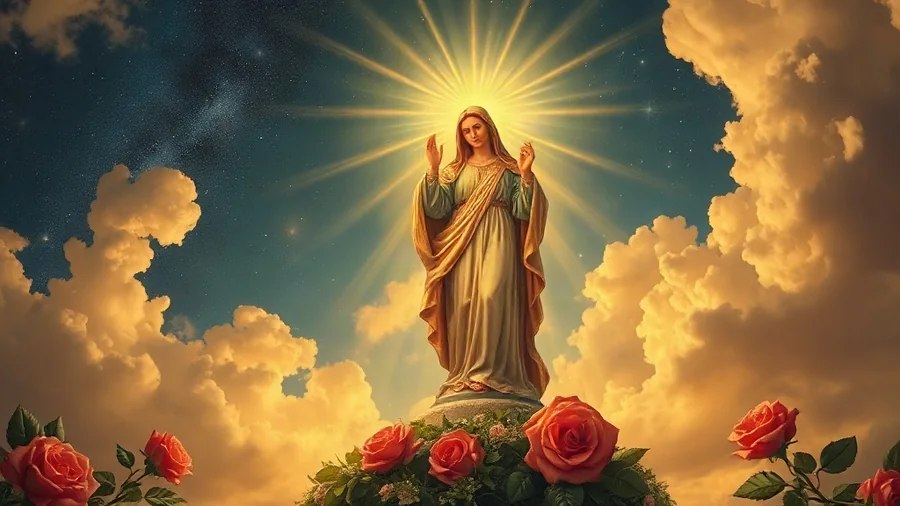
The historical trajectory of the "astronomical thesis" regarding the Guadalupe mantle is a journey of evolving interpretations. The tradition establishes that the apparitions occurred in 1531, culminating in the miraculous imprint of the image on the tilma. For centuries, the stars were viewed primarily as symbolic attributes of the Queen of Heaven. However, it was not until the modern era that researchers began to apply astronomical software and historical planetary data to determine if the 46 stars on the mantle corresponded to a specific moment in time. This effort sought to move the conversation from the purely devotional to the empirically verifiable, attempting to anchor the miracle in a precise chronological and spatial coordinate: the dawn of December 12, 1531.
A pivotal moment in this intellectual pursuit occurred around 2002, when reports emerged regarding collaborations between researchers and the Laplace Observatory. These studies proposed that the stars were not placed randomly but reflected a "cosmocentric" perspective of the winter solstice of 1531. This line of inquiry was further expanded in 2012 by Fernando Ojeda, who published a detailed proposal identifying twelve specific constellations and the planet Jupiter. Ojeda’s research suggests that the arrangement of the stars corresponds precisely to the sky visible at 6:45 a.m. on the morning of December 12, 1531, effectively turning the mantle into a celestial clock that marks the exact moment of the Virgin's manifestation to Juan Diego.
Despite these compelling theories, the historical-critical school maintains a necessary caution. Scholars emphasize that there is a conspicuous absence of 16th-century documentary evidence—such as diaries, letters, or early descriptions—that identifies the mantle as an astronomical map. This gap in the primary record suggests that the astronomical reading is a posterior interpretation, a "retro-analysis" applied to the image centuries after the event. Furthermore, some critics and historians, particularly in discussions surfacing between 2008 and the present, argue that the stars may have been added or modified by human hands in later centuries, which would fundamentally undermine the thesis of an original, divinely imprinted celestial code.
In the contemporary landscape, between 2019 and 2023, popular discourse has continued to amplify the identification of specific constellations such as Ursa Major, Libra, Scorpio, Centaurus, Draco, Auriga, Ophiuchus, and the Southern Cross. While these claims resonate deeply with the faithful, they remain a subject of academic tension. The debate thus stands as a duality: on one side, the theological conviction that the image is a providential sign of cosmic harmony; on the other, the rigorous demand for historical corroboration. As a curator and researcher, I observe that this tension does not diminish the image's power but rather highlights its role as a bridge between the mysteries of faith and the quest for scientific truth.
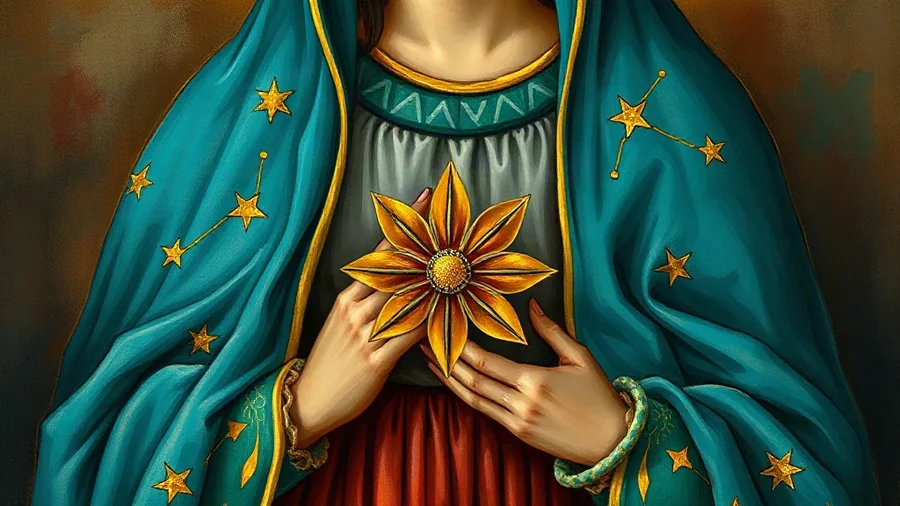
Theologically, the starry mantle of Our Lady of Guadalupe functions as a visual manifestation of the "Woman clothed with the sun" described in the Book of Revelation. By wearing the stars, Mary is identified not only as a human mother but as the Queen of All Creation. The inclusion of the heavens upon her garment symbolizes her role as the Mediatrix, the bridge between the celestial hierarchy and the earthly realm. In the context of the 16th-century encounter between Spanish Catholicism and the indigenous Nahua culture, this symbolism was profoundly strategic. The Nahuas possessed a sophisticated understanding of the cosmos; for them, a figure who "carried the stars" was a being of supreme authority and divine origin, signaling that the message she brought was in harmony with the laws of the universe.
Furthermore, the specific mention of Jupiter in some astronomical interpretations carries significant theological weight. In classical and medieval symbolism, Jupiter was often associated with sovereignty, justice, and the divine will. If the planet Jupiter is indeed encoded within the mantle, it reinforces the image of Mary as the royal consort of the King of Kings. The alignment of the stars thus becomes a "sacred geometry," where the physical placement of celestial bodies serves as a silent sermon on the order and providence of God. It suggests that nothing in the creation is accidental, and that the Incarnation—and the subsequent protection of the Mother—is the central axis around which the entire cosmos revolves.
From a Marian perspective, the stars also represent the "Cloud of Witnesses" and the communion of saints. The 46 stars can be seen as a representation of the multitude of the redeemed, gathered around the Virgin. This transforms the mantle into a sanctuary of light, reminding the believer that the path to salvation is illuminated by the grace of God. The "cosmic" nature of the image speaks to the universality of the Church; the Virgin of Guadalupe is not merely the patroness of Mexico, but a Mother to all humanity, whose mantle is wide enough to encompass the entire sky and all the souls beneath it.
Ultimately, the spiritual meaning of the starry mantle lies in the concept of "Divine Harmony." Whether the stars are a mathematically precise map of 1531 or a symbolic representation of celestial glory, the effect on the believer is the same: a sense of peace born from the knowledge that the heavens are not distant or indifferent, but are intimately connected to the history of human salvation. The mantle is a reminder that the Divine enters human history at a specific time and place, yet does so with a perspective that encompasses eternity. In the silence of the stars, the believer finds a reflection of the infinite love of God, tailored into a garment of maternal tenderness.
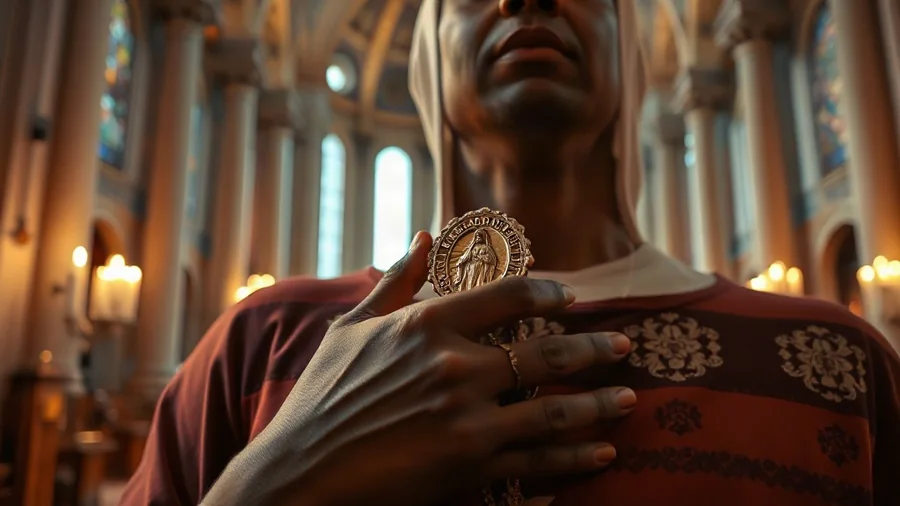
As a curator of sacred jewelry, I find that the desire to honor the Virgin of Guadalupe often manifests in the creation of exquisite devotional pieces that mirror the celestial beauty of her mantle. When translating the "starry" essence of the tilma into gold and silver, the choice of materials is paramount to ensure both spiritual dignity and material longevity. 14K gold is the preferred standard for high-end devotional medals; its alloy provides the perfect balance between the purity of the metal and the structural integrity required for intricate detailing. The warm, eternal glow of 14K gold symbolizes the divine light of the Sun that surrounds the Virgin, creating a piece that is not merely an accessory, but a portable shrine.
For the representation of the stars and the mantle's deep hues, 925 Sterling Silver is often employed, sometimes treated with an oxidized finish or combined with precious gemstones like sapphires or diamonds to mimic the night sky. The contrast between the brilliance of the gold and the cool luminosity of the silver evokes the duality of the sun and stars present in the Guadalupe iconography. In professional sacred goldsmithing, the use of "repoussé" and "chasing" techniques allows the artisan to create a three-dimensional effect, giving the Virgin's mantle a tactile depth that echoes the texture of the original agave fiber, while elevating it to the status of a precious heirloom.
Authenticity in sacred jewelry is guaranteed through the use of hallmarks. A genuine piece of devotional art should bear the "925" stamp for silver and the appropriate karat mark for gold. These hallmarks are not merely commercial requirements but are signatures of quality and truth, mirroring the search for authenticity in the historical study of the tilma. When selecting a piece of sacred jewelry, one must look for the precision of the engraving; the stars on a Guadalupe medal should be rendered with a delicacy that suggests celestial light rather than mere mechanical repetition. This attention to detail is what separates a mass-produced trinket from a work of sacred art.
The care of these heirlooms is a spiritual practice in itself. To maintain the luster of 14K gold and 925 silver, one should avoid abrasive chemicals, using instead a soft microfiber cloth and mild soap. Over time, silver may develop a patina, which many collectors of sacred art value as a sign of the piece's history and the prayers it has witnessed. By treating these objects with reverence, the owner acknowledges that the metal is a vessel for devotion. A well-preserved Guadalupe medal, passed down through generations, becomes a tangible link to ancestral faith, carrying the "light of the stars" from one generation to the next.
18K Gold Plated / Baño de Oro 18K con acabado de orfebrería fina.
Prime Delivery Guaranteed
18K Gold Plated / Baño de Oro 18K con acabado de orfebrería fina.
Prime Delivery Guaranteed
Gold Plated / Chapa de Oro con acabado de orfebrería fina.
Prime Delivery GuaranteedWhen selecting a Guadalupana piece, always prioritize certified precious metals (solid nickel-free 14K gold or Italian 925 sterling silver). Upon receiving it, take it to your parish priest for a traditional Catholic blessing to consecrate it as an enduring sacramental of protection.

18K Gold Plated / Baño de Oro 18K con acabado de orfebrería fina.
Prime Delivery Guaranteed
Stainless Steel / Acero Inoxidable con acabado de orfebrería fina.
Prime Delivery Guaranteed
18K Gold Plated / Baño de Oro 18K con acabado de orfebrería fina.
Prime Delivery GuaranteedThe thesis that the stars on the mantle represent the sky of December 12, 1531, is a compelling hypothesis supported by some astronomical reconstructions and researchers like Fernando Ojeda. These studies suggest a precise alignment with constellations such as Ursa Major and the planet Jupiter, which would serve as a divine "time stamp" of the apparition. For many, this provides a powerful intersection between science and faith, suggesting a cosmic orchestration of the event. However, it is important to note that this is not a consensus among historians or scientists. The primary critique is the lack of contemporaneous 16th-century documentation that describes the stars as a celestial map. Furthermore, the possibility of later human interventions in the image means that the astronomical pattern cannot be verified as an original feature of the 1531 imprint. Thus, while it is a beautiful and spiritually enriching interpretation, it remains a matter of faith and theoretical research rather than an established historical fact.
To ensure the authenticity of a sacred piece, first examine the hallmarks. A high-quality silver piece must be stamped with "925," indicating sterling silver, while gold pieces should be marked with their karat weight (e.g., "14K" or "585"). Beyond the stamps, observe the craftsmanship; a genuine piece of sacred jewelry will have crisp, intentional lines and a balanced weight. In the case of 14K gold, the metal should have a consistent, rich color without signs of peeling or discoloration, which would indicate a mere plating. Additionally, I recommend purchasing from reputable curators or established religious goldsmiths who provide a certificate of authenticity. This document should specify the purity of the metals and the origin of the piece. When in doubt, a professional jeweler can perform a non-destructive acid test or use an X-ray fluorescence (XRF) analyzer to confirm the exact composition of the metal, ensuring that your act of devotion is supported by material truth.
When selecting devotional jewelry, such as a Guadalupe medal, one should prioritize the "intention" of the piece. Choose a design that resonates with your spiritual journey—whether it is a minimalist silver cross or an ornate gold medal reflecting the starry mantle. The material should be durable enough for daily wear; 14K gold is ideal for those who never wish to remove their jewelry, as it resists tarnish and wear more effectively than lower karats or plated metals. In terms of wearing these pieces, the Catholic tradition suggests that they be worn with reverence. While they can be worn as fashion statements, their primary purpose is to serve as a "sacramental"—a reminder of God's presence and the intercession of the Virgin. It is common practice to have the medal blessed by a priest, which transforms the object from a piece of jewelry into a consecrated tool for prayer. Wearing the medal close to the heart symbolizes a personal and intimate connection with the Mother of God.
The transmission of a sacred heirloom, such as a gold Guadalupe medal, creates a "spiritual genealogy" within a family. When a grandmother passes a medal to her granddaughter, she is not merely transferring a precious metal, but a legacy of faith, a history of answered prayers, and a tradition of devotion. These objects become anchors of memory, reminding the younger generation that they are part of a larger story of grace that transcends their own lifetime. Incorporating these heirlooms into family prayer—such as during the month of the Rosary or on the feast of December 12—strengthens the familial bond. The physical act of touching the metal, worn by ancestors, provides a tangible connection to the past and a sense of continuity. In an increasingly digital and ephemeral world, these enduring pieces of gold and silver serve as permanent witnesses to the family's commitment to the Gospel and their enduring love for the Virgin of Guadalupe.
Affiliate Disclosure: As an Amazon Associate, this devotional portal earns from qualifying purchases at zero additional cost to you.
Find the perfect sacred piece in 3 simple steps
Handpicked based on your preferences and occasion