Laura's Selection
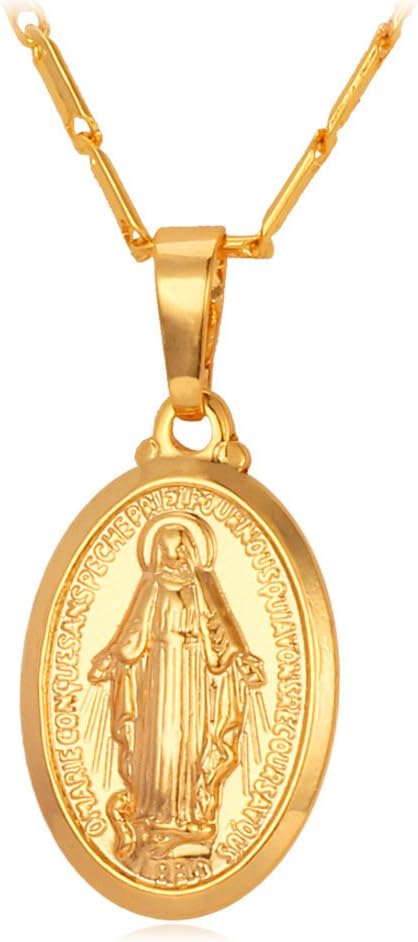
U7 Virgin Mary Necklace for Women,18K Gold Plated/Sterling Silver
18K Gold Plated / Baño de Oro 18K con acabado de orfebrería fina.
Prime Delivery Guaranteed
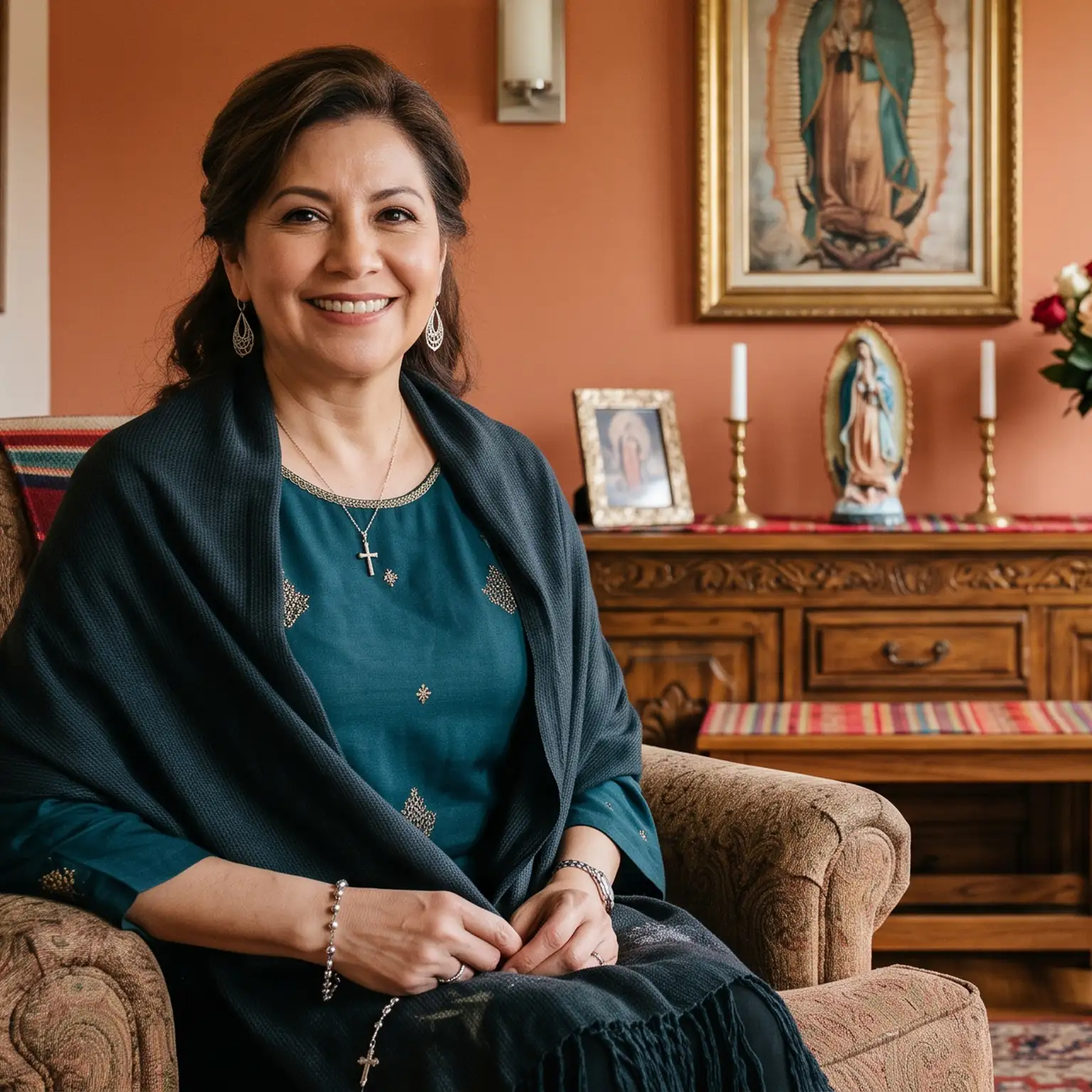
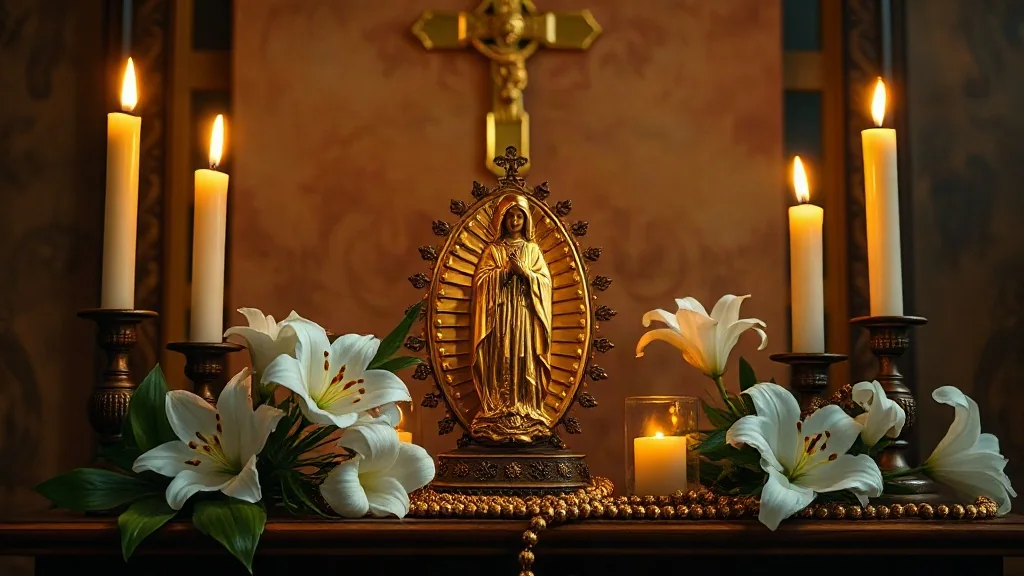
The image of Our Lady of Guadalupe is not merely a religious painting or a cultural artifact; it is a profound theological synthesis, a "codex" of divine revelation written upon the humble fibers of an ayate. To the trained eye of a historian and a devotee, the tilma serves as a bridge between two worlds—the ancestral cosmovision of the Nahua peoples and the timeless truths of the Catholic faith. This image does not seek to impose a foreign deity but to reveal the Incarnation through a visual language that was immediately intelligible to the indigenous population of 16th-century Mexico. The spiritual significance lies in its capacity to act as a maternal embrace, where the Virgin Mary presents herself not as a distant queen, but as a mestiza mother, weaving together the fragmented identities of a conquered people into a new, unified spiritual reality under the mantle of Christ. From a curatorial perspective, the Guadalupe image represents the pinnacle of "sacred visuality." Every line, color, and gesture is intentional, functioning as a silent sermon that speaks of humility, intercession, and the dawn of a new era of grace. The image transcends the boundaries of art history to enter the realm of the supernatural, where the material support—the coarse agave fiber of the tilma—contrasts sharply with the celestial nobility of the figure depicted. This paradox is the essence of the Guadalupan message: the highest divinity manifesting in the lowest of materials, mirroring the mystery of the Word becoming flesh. For the believer, contemplating these symbols is an act of prayer; for the researcher, it is an exploration of how the Divine communicates through the specific cultural markers of humanity to lead them toward a universal truth.
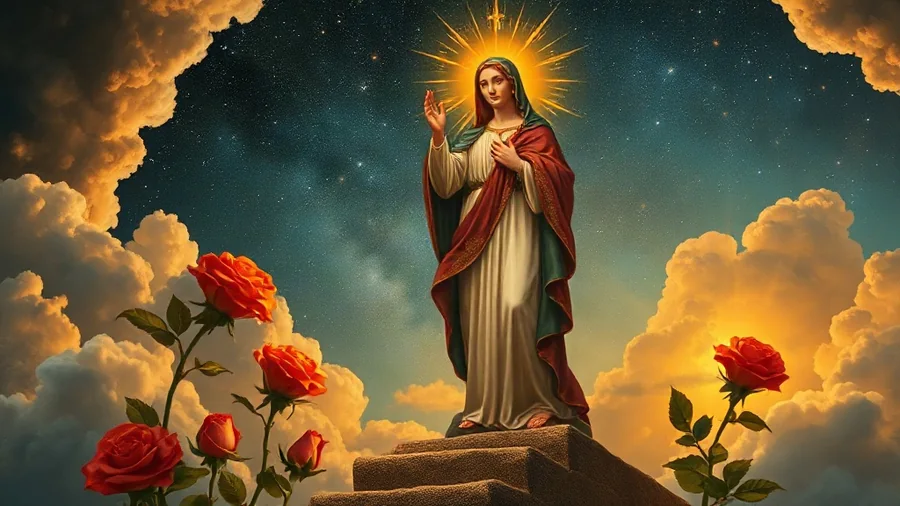
The historical genesis of the Guadalupan devotion is anchored in the winter of 1531, specifically culminating on December 12th. According to tradition and the earliest chronicles, the Virgin Mary appeared to Juan Diego, a humble macehual (commoner), on the hill of Tepeyac. This location was not accidental; Tepeyac had been a site of devotion to the mother-goddess Tonantzin, and the apparition thus signaled a spiritual transformation of the site, redirecting the indigenous longing for a maternal deity toward the true Mother of God. The request for a temple and the subsequent miracle of the Castilian roses in December—a season when such flowers cannot bloom in the Valley of Mexico—served as the divine "credential" that validated the message to Bishop Zumárraga.
During the early 16th century, the image was interpreted through a dual lens. To the Spanish clergy, it was a manifestation of the Immaculate Conception and the triumph of the Cross. However, for the indigenous population, the image functioned as a visual bridge. By 1576, certain codices and early colonial records began to document the specific floral motifs on the tunic, linking them to the concepts of pilgrimage and the nobility of the New Spanish lands. This period of early interpretation is crucial, as it demonstrates that the image was not "read" as a European painting, but as a sacred document containing specific signs that spoke to the heart of the Nahua experience, facilitating one of the most massive conversions in the history of the Church.
The material nature of the tilma—the ayate—adds a layer of historical and symbolic density. The ayate is a garment of the poor, made from the fibers of the maguey plant. That the image appeared on such a fragile and humble support is a historical testament to the "preferential option for the poor" long before the term was coined. Historically, the preservation of the image over centuries, despite the organic nature of the fabric, has been a subject of intense study. The lack of visible brushstrokes or known pigments of the era adds a dimension of mystery that elevates the image from a work of human art to a supernatural sign, a "miraculous canvas" that has survived the humidity and the passage of time.
Modern iconographic studies have further refined our understanding of the chronology and meaning of the symbols. Contemporary researchers emphasize that the arrangement of the stars, the position of the moon, and the rays of the sun are not random decorative elements but a precise theological map. The image organizes itself to express the Divine Maternity of Mary and the Incarnation of Christ. By analyzing the visual syntax—the tilt of the head, the joined hands, and the black sash—historians can see a deliberate effort to communicate that Mary is the "Woman clothed with the sun," the one who brings the Light of the World into the darkness of human history, specifically within the American context.
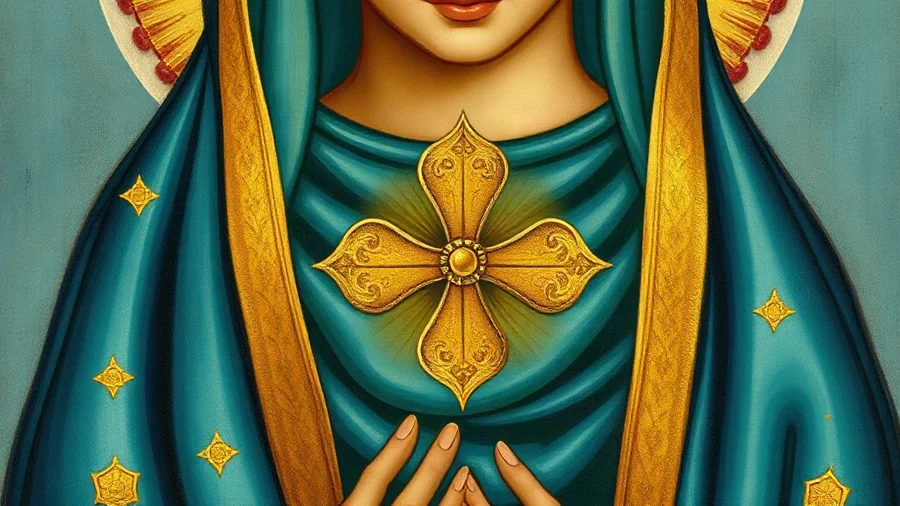
The theology of the Guadalupe image is centered not on Mary herself, but on her role as the *Theotokos*—the God-bearer. The visual center of the composition is not her face, but her womb, which is highlighted by the black sash (cinturón) and the four-petaled flower, the *Nahui Ollin*. In Nahua symbolism, the *Nahui Ollin* represents the center of the universe, the point of maximum density where the divine presence resides. By placing this symbol over her womb, the image declares that the Creator of the Universe is now residing within her. Mary is thus presented as the Tabernacle of the Most High, the bridge through which the Infinite enters the finite.
Furthermore, the image resolves a complex theological tension: the simultaneous reality of Mary as Virgin and Mother. The loose hair, which in indigenous culture was a sign of virginity, contrasts with the black sash, a clear indicator of pregnancy. This visual paradox is a catechesis on the Virginal Conception. The gaze of the Virgin, inclined downward and filled with tenderness, removes any notion of imperial dominance. She does not look at the viewer as a judge, but as a mother who listens. Her joined hands are a gesture of intercession and humility, signaling that she does not perform the miracle, but points the way toward her Son.
The celestial elements—the sun and the moon—provide a cosmic framework for the message. Mary appears in front of the sun, creating a solar eclipse; she is "clothed with the sun," yet she does not obscure it, but rather mediates its light. For the indigenous people, who revered the sun as a primary deity, this was a revolutionary statement: the Mother of God is greater than the sun, yet she serves the Light of the World. The crescent moon beneath her feet signifies her dominion over the created order and the triumph of the New Covenant over the old potencies. It also links the image to the toponymy of Mexico, which in Nahuatl means "in the place of the navel of the moon."
Ultimately, the image functions as a synthesis of two languages. The Nahuatl language provides the signs of pregnancy, nobility (the turquoise mantle), and cosmic center, while the Christian language provides the context of salvation and grace. The mestizo features of the Virgin—her skin tone and facial structure—are a theological statement on the universality of the Church. She is the first "Mestiza," the bridge between the Old World and the New, announcing that in Christ, all divisions are healed. The image is not a portrait of a woman, but a visual manifesto of the Incarnation, proclaiming that God has chosen a humble people and a humble woman to bring about the redemption of all humanity.
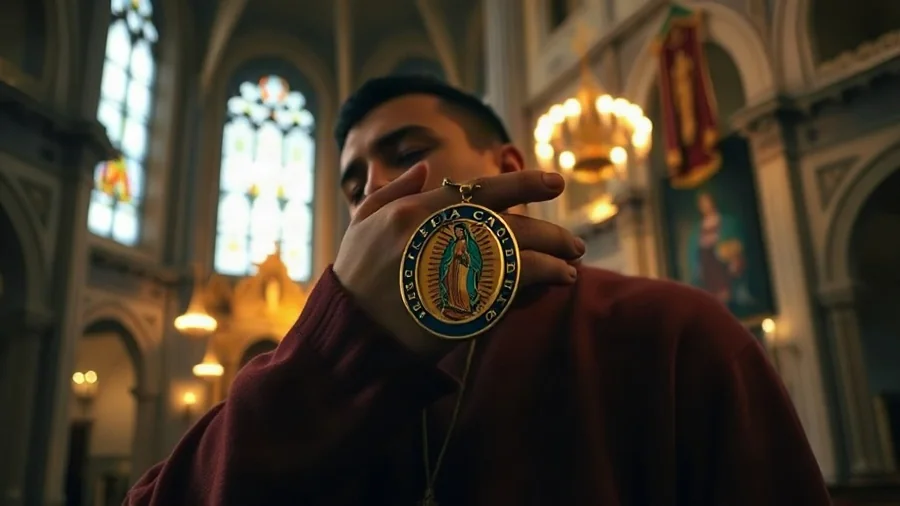
As a curator of sacred jewelry, I find that the translation of the Guadalupan image into precious metals is an act of "material prayer." When commissioning or selecting devotional pieces, the choice of metal is never merely aesthetic; it is an extension of the theology of the image. 14K gold is the preferred medium for representing the "Sun" and the "Divine Light" that surrounds the Virgin. Gold, being incorruptible and timeless, mirrors the eternal nature of the Divine Grace. In high-end sacred goldsmithing, the use of 14K gold provides the perfect balance between purity and structural integrity, allowing for the intricate detailing of the *Nahui Ollin* and the delicate rays of the mandorla.
Conversely, 925 Sterling Silver is employed to represent the "Moon" and the "Purity" of the Virgin. The cool, reflective quality of silver evokes the lunar light and the virginal nature of Mary. In the creation of a high-quality Guadalupe medal, the juxtaposition of gold and silver—often through the technique of *two-tone* casting or gold plating over silver—creates a visual harmony that reflects the duality of the image: the solar and the lunar, the divine and the human. The hallmark "925" is not just a legal requirement for authenticity; it is a guarantee that the object is worthy of the sacred image it bears, ensuring that the piece will not tarnish rapidly or cause allergic reactions, thus maintaining its dignity as a sacramental.
The craftsmanship of these pieces requires a rigorous adherence to traditional techniques. Deep relief (alto relieve) is essential to capture the folds of the turquoise mantle and the serenity of the Virgin's expression. A master goldsmith must ensure that the edges are polished to a mirror finish, preventing any discomfort to the wearer, as these pieces are often worn close to the skin as a sign of protection and devotion. The setting of small gemstones—such as turquoise to mirror the mantle or diamonds to represent the stars—elevates the piece from a simple ornament to an "ex-voto" of luxury, where the value of the materials is offered as a sacrifice of love to the Queen of Heaven.
Preserving these heirlooms requires a disciplined approach to care. Sacred jewelry, especially those crafted in 14K gold and 925 silver, should be cleaned with a soft, lint-free cloth and avoided contact with harsh chemicals. However, the "patina" that develops over generations of wear is often seen as a mark of ancestral faith. When a Guadalupe medal is passed from grandmother to granddaughter, the metal carries the spiritual weight of the prayers whispered over it. As a curator, I advise that these pieces be stored in silk-lined boxes to prevent scratches, treating them not as jewelry, but as portable shrines that connect the wearer to the celestial patronage of the Virgin of Guadalupe.
18K Gold Plated / Baño de Oro 18K con acabado de orfebrería fina.
Prime Delivery Guaranteed
Gold Plated / Chapa de Oro con acabado de orfebrería fina.
Prime Delivery Guaranteed
Stainless Steel / Acero Inoxidable con acabado de orfebrería fina.
Prime Delivery GuaranteedWhen selecting a Guadalupana piece, always prioritize certified precious metals (solid nickel-free 14K gold or Italian 925 sterling silver). Upon receiving it, take it to your parish priest for a traditional Catholic blessing to consecrate it as an enduring sacramental of protection.

18K Gold Plated / Baño de Oro 18K con acabado de orfebrería fina.
Prime Delivery Guaranteed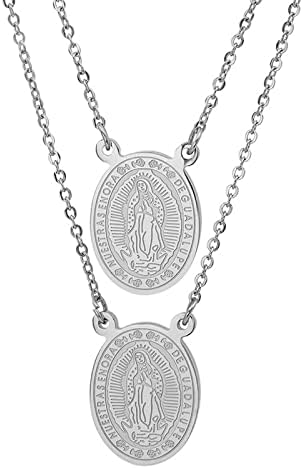
18K Gold Plated / Baño de Oro 18K con acabado de orfebrería fina.
Prime Delivery Guaranteed
14K Solid Gold / Oro 14K Sólido con acabado de orfebrería fina.
Prime Delivery GuaranteedThe *Nahui Ollin* is a four-petaled flower located precisely over the womb of the Virgin. In the indigenous Nahua cosmovision, this symbol represents the "center of the four directions," the axis mundi, and the presence of the Divine. It is the symbol of the maximum density of energy and the center of time and space. By placing this symbol on the tilma, the image communicates that the center of the universe—God Himself—is now present within the womb of Mary. Theologically, this transforms the image from a portrait into a declaration of the Incarnation. It tells the viewer that the "True God," whom the indigenous peoples had sought in the center of their cosmos, has arrived in human form. The flower serves as a visual anchor, directing the observer's attention away from the periphery and toward the mystery of the Christ Child, making the womb of Mary the new center of the world's salvation.
A genuine 925 Sterling Silver medal will always bear a hallmark—usually a small "925" stamped into the metal, often on the bail or the reverse side. Beyond the stamp, silver has a specific weight and a characteristic "ring" when lightly tapped. More importantly, genuine silver develops a natural oxidation (tarnish) over time, which is a dark grey or black film that can be easily removed with a professional polishing cloth. Plated imitations, on the other hand, often "peel" or reveal a copper or brass base underneath as the thin layer of silver wears off. From a spiritual and curatorial standpoint, the authenticity of the metal reflects the authenticity of the devotion. Using a noble metal like silver ensures that the object is durable and respectful of the image it portrays. I always recommend purchasing from established goldsmiths who provide a certificate of authenticity, as a sacred object should be a reflection of truth and quality, mirroring the purity of the Virgin it commemorates.
When selecting devotional jewelry, one should prioritize the "sacredness of the image" over the "trend of the design." The image of the Virgin of Guadalupe is rich in symbolism; therefore, the jewelry should not distort these features. Look for pieces where the proportions of the mandorla, the tilt of the head, and the position of the hands are faithful to the original tilma. A piece that is too stylized may lose the theological depth of the original image. Regarding the wearing of these pieces, it is traditional to wear them close to the heart, symbolizing a personal and intimate relationship with the Mother of God. Whether it is a 14K gold chain or a silver rosary, the jewelry should be treated as a sacramental—an object that disposes the soul to receive grace. It is highly recommended to have the piece blessed by a priest, which transforms the object from a piece of jewelry into a spiritual tool for prayer and protection.
Sacred jewelry acts as a "tangible memory" of faith. When a Guadalupe medal is passed down through generations, it becomes a vessel for the spiritual history of the family. The piece is no longer just gold or silver; it is imbued with the prayers, tears, and gratitude of the ancestors who wore it. This creates a powerful psychological and spiritual link between the living and the departed, fostering a sense of continuity in the faith. In the context of family prayer, these heirlooms serve as a focal point. A daughter wearing her grandmother's medal is reminded of the virtues of her predecessors and the enduring protection of the Virgin. This legacy encourages the younger generation to maintain a devotional life, as the physical object serves as a constant reminder that they are part of a larger, sacred lineage. In this way, sacred goldsmithing transcends art and becomes a catalyst for the transmission of the faith from one generation to the next.
Affiliate Disclosure: As an Amazon Associate, this devotional portal earns from qualifying purchases at zero additional cost to you.
Find the perfect sacred piece in 3 simple steps
Handpicked based on your preferences and occasion